
CO₂ — LUVE, the Natural Leader
When the natural innovation meets efficiency, the future blooms in green and sustainability
CO₂ — The Natural Leader
Innovation in refrigeration: the use of CO₂ refrigerant
A revolutionary solution
In the refrigeration industry, the use of CO₂ fluid is becoming increasingly popular as a revolutionary solution to eliminate the greenhouse effect caused by halogenated hydrocarbons in the HFC category.
The Global Warming Potential (GWP) of CO₂ is indeed very low compared to HFCs (1 against several thousand); moreover, CO₂ does not present any problems of toxicity, flammability or impact on the ozone layer.
- zero Global Warming Potential (GWP) values
- low or zero Ozone Depletion Potential (ODP) values
- no PFAS
GWP is an indicator that quantifies the impact of a greenhouse gas on global warming. ODP indicates the ability of a substance to damage the atmospheric ozone layer. PFAS are known as “forever chemicals” – compounds that never degrade in either the environment or in the human body, accumulating over time and causing serious risks for human health and the ecosystem.
Compatible products for CO₂ refrigerant

The designer's challenge: efficiency and innovation
CO₂ presents unique challenges compared to traditional HFCs, requiring the right technology to match or exceed HFC efficiency.
LUVE has addressed this by investing in CO₂ research and developing a specialized test plant with a unique climatic chamber in Europe to advance heat exchanger efficiency.
R&D laboratory in Uboldo at the forefront in Europe in terms of size and competence, as it is one of the few in the world capable of conducting performance tests on appliances that use CO₂ as a refrigerant fluid.

Is CO₂ efficient?
The appropriate choice of heat exchanger technology is the key for obtaining high values for the system Coefficient of Performance (COP), in order to get a real reduction of energy consumption. Tens of projects with Universities and Research Institutes, coupled with pilot installations all over the World, contributed to make LUVE a leading company in CO₂ technology.

Technological advances in testing
LUVE has four R&D laboratories, in Uboldo (Varese, Italy), Alonte (Vicenza, Italy), Flumignano di Talmassons (Udine, Italy) and Vantaa (Finland).
The R&D laboratory in Uboldo is at the forefront in Europe in terms of size and competence, as it is one of the few in the world capable of conducting performance tests on appliances that use CO₂ as a refrigerant fluid.
The Climatic Chamber at Flumignano di Talmassonsons is instead one of the largest proprietary climatic chambers in Europe and the first laboratory dedicated to performance testing of dry and adiabatic liquid coolers.
Collaboration and Research
LUVE teams with Politecnico di Milano and industry leaders to refine CO₂ heat exchanger technology, enhancing efficiency and reducing greenhouse impact.
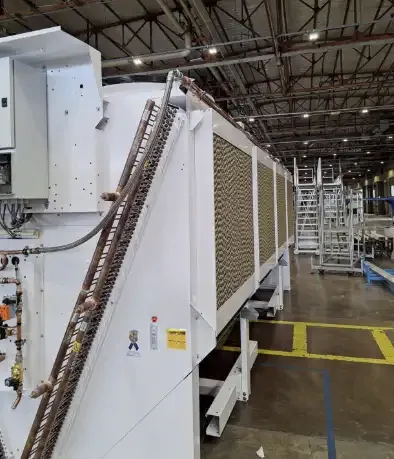
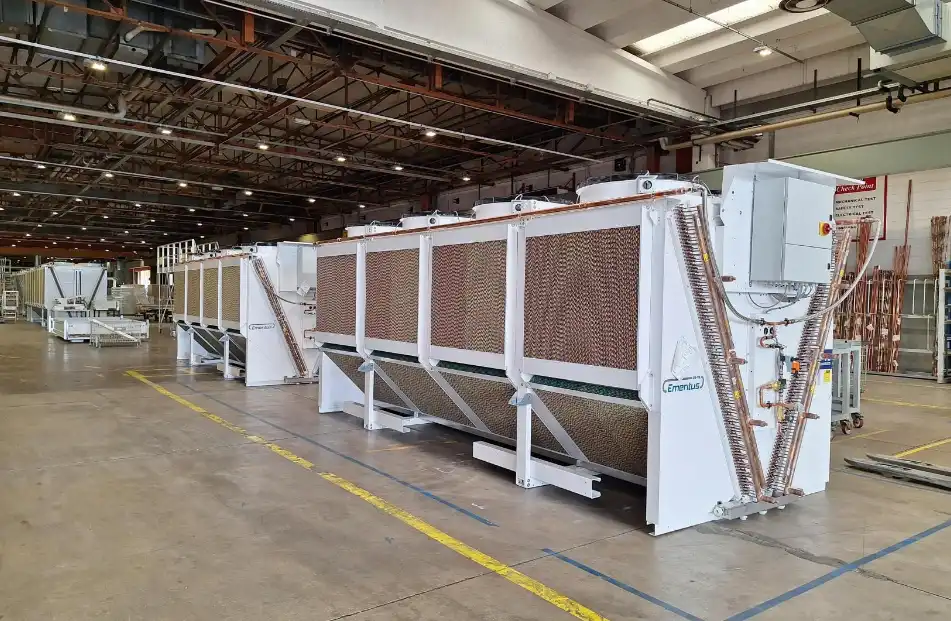
CO₂ Gas Coolers and Evaporators
LUVE offers specialized CO₂ Gas Coolers and evaporators designed to leverage the unique properties of CO₂ as a refrigerant.
This product line includes various air coolers and evaporators for commercial and industrial applications, such as cubic and angled coolers, dual discharge coolers, and single/double V-Coil gas coolers.
These solutions are optimized for high efficiency and have numerous successful installations globally.
Experts in natural fluid
The challenge to move further south “the CO₂ equator” and make this technology efficient even in countries where it was previously not possible began in 2018 with two pilot plants in India (INDEE Project at the ITT – Indian Institute of Technology Madras in Chennai) and in Amman, Jordan. In detail, one of the most advanced CO₂ refrigeration systems for supermarkets in the region is in operation in Jordan, as part of a project developed by the United Nations Industrial Development Organization (UNIDO), with the support of the Jordanian Ministry of the Environment. In recent years, LUVE, thanks to its unique experience, has been investing on the Refrigeration Market in the USA, contributing to establish CO₂ technology as common standard, following the European journey.
The importance of calibration
Tens of projects with Universities and Research Institutes, coupled with pilot installations all over the World, contributed to make LUVE a leading company in CO₂ technology. Many aspects, such as the influence of oil on internal heat transfer coefficient, have been included in the scope of the research. The main result of these activities is the creation of a calibration software that calculates product performance very precisely.
In particular, it was possible to calibrate a specific method able to take into account the behavior of the fluid during trans-critical cooling, properly considering all the parameters affecting real performance.